Design Your KDP Success: A Guide to Professional Book Cover Templates
In the bustling world of Amazon Kindle Direct Publishing (KDP), the competition is fierce. Thousands of books are uploaded every day, each vying for the attention of potential readers scrolling through endless digital shelves. In this visual marketplace, your book’s cover is not just decoration; it is your primary marketing tool, your first—and sometimes only—chance to make an impression. For many aspiring authors and self-publishers, the challenge of designing a compelling, professional cover can feel overwhelming, a technical hurdle standing between them and their publishing dreams. This is where professionally designed, editable book cover templates become not just a tool, but a strategic advantage.
The Critical Role of Your Book Cover in KDP Success
Before diving into the practical solution of templates, it’s essential to understand the problem they solve. A book cover serves multiple crucial functions in the self-publishing ecosystem. First, it communicates genre and tone instantly. A romance novel looks distinct from a gritty thriller or a scholarly non-fiction work. Second, it establishes quality and credibility. A poorly designed, amateurish cover signals to readers that the content inside might also be unpolished, regardless of how brilliant the manuscript may be. Finally, it triggers an emotional response—curiosity, excitement, intrigue—that leads to the single most important action: a click.
On Amazon, this click is everything. Your cover thumbnail appears alongside dozens of others in search results and category listings. Its quality directly influences your book’s Click-Through Rate (CTR), a key metric in the platform’s complex algorithms. A higher CTR can lead to better visibility, more organic reach, and ultimately, more sales. Therefore, investing in a professional presentation is not an artistic luxury; it is a foundational business decision for any KDP author.
The Barrier of DIY Design
Many enter the KDP journey with enthusiasm for their writing but limited skills in graphic design. Attempting to create a cover using basic software can result in mismatched fonts, low-resolution images, unbalanced layouts, and colors that fail to resonate with the target audience. Furthermore, understanding the technical specifications for KDP—such as the correct trim size (like the popular 6 x 9 inches), spine width calculations based on page count, and bleed areas—adds another layer of complexity. Common misunderstandings here, such as assuming any image will look good or that spine design is unimportant for paperback, can lead to rejected uploads or a physically flawed final product. This is where a pre-designed, expertly crafted template bridges the gap.
What Are Editable KDP Book Cover Templates?
An editable KDP book cover template is a complete, ready-to-use digital file designed specifically for Amazon’s paperback format. Think of it not as a finished, locked image, but as a sophisticated starting point. A professional designer has already handled the hardest parts: establishing a visually striking composition, selecting complementary fonts, creating a balanced color palette, and ensuring all technical dimensions are perfect for KDP’s requirements. The author then receives this framework in an editable format, typically for use in software like Adobe Photoshop, Canva, or Affinity Publisher.
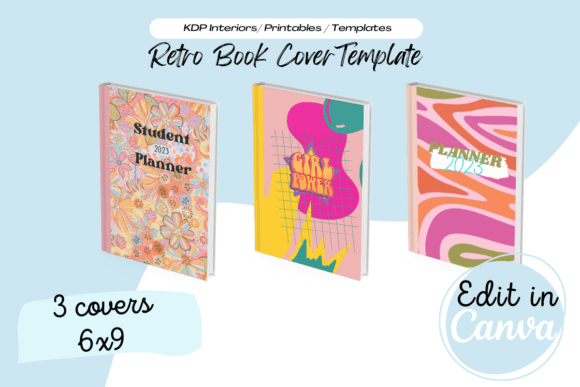
The true power lies in what you, the author, can do with this framework. As outlined in products like Retro Themed KDP Book Cover Templates or a Retro 6 x 9 Book Covers Template, the editable features are extensive. You can change every text element—title, subtitle, author name—to your own, experimenting with the provided fonts or changing them entirely. You can reorder pages or layers, shift images, and modify colors to better suit your story’s mood. You can integrate your own branding, perhaps by adding a series logo or a personal author insignia. This process transforms a generic professional design into a unique cover that embodies your specific book.
The Significance of a "Retro" Theme and Other Styles
Thematic templates, such as those with a retro aesthetic, serve a deeper purpose. "Retro" is not merely a style; it’s a direct communication channel to a specific audience. A cover featuring classic typography, vintage color schemes, and nostalgic imagery immediately signals genres like historical fiction, mid-century memoirs, or certain styles of science fiction and fantasy. It tells the reader, before they read a single word of the blurb, “This book contains a certain tone and experience.”
Using a themed template ensures your cover is coherent and genre-appropriate from the start. It guides your customization, preventing the common mistake of creating a visually confused cover that tries to appeal to everyone but resonates with no one. Other template themes—minimalist, modern, thriller, romance, academic—perform the same function, acting as a design mentor that keeps your creative edits on the right track.
Practical Relevance: How Templates Make Your KDP Journey Easier
The promise that such templates are “designed to make your KDP journey a little easier” is fulfilled in several concrete ways. Let’s explore the practical relevance across the key stages of publishing.
Time and Cost Efficiency
Hiring a freelance cover designer can cost hundreds of dollars and require weeks of back-and-forth communication. For authors on a tight budget or schedule, this is a significant barrier. A high-quality template offers a professional result at a fraction of the cost and time. You bypass the learning curve of advanced design software and the trial-and-error of DIY attempts. The hours saved can be redirected toward marketing, writing your next book, or connecting with your readers.
Creative Control Without Technical Anxiety
Many authors cherish creative control over their entire project. A template provides a safe environment for this control. You are free to experiment—change fonts, tweak colors, move images—but you are doing so within a structure that already works. The underlying layout ensures your experiments won’t break the fundamental rules of good design or KDP’s technical guidelines. This reduces anxiety and empowers you to personalize the cover until it feels perfectly aligned with your vision.
Consistency for Series and Branding
If you are publishing a series of books, consistency across covers is vital for brand recognition. Using the same template (or a set of templates from the same family) for each book ensures a cohesive look. You can maintain the same font hierarchy, color themes, and layout structure, only changing the title and key imagery. This builds a visual identity that readers can trust and follow, making your entire author brand stronger and more professional.
Example: Utilizing a Retro 6 x 9 Template
Imagine you’re publishing a novel set in the 1970s. You purchase a Retro 6 x 9 Book Covers Template. The template file opens in your design software. You see a beautifully composed cover with a vintage-inspired background texture, a bold, classic font for the title, and a stylized placement for the author name. Your work begins:
- You change the title text to your novel’s name, “Electric Sunshine.”
- You decide the provided orange hue is perfect and leave it, reinforcing the retro feel.
- You use the template’s instruction to calculate your spine width based on your manuscript’s page count and adjust the spine text effortlessly.
- You add your own logo, a small stylized vinyl record, to the back cover as a branding element.
- Within an hour, you have a unique, genre-perfect, technically accurate cover ready for upload, all without ever struggling with layout grids or font pairing rules.
This practical process demystifies cover creation, turning it from a daunting obstacle into an enjoyable part of the publishing journey.
Fitting Into the Modern Creative & Business Landscape
The availability of such tools reflects a broader trend in modern creativity and entrepreneurship: the democratization of professional-grade resources. Just as website builders allow anyone to create a sleek online store, and social media templates help small businesses craft consistent content, KDP cover templates empower individual authors to compete in a global marketplace. They align perfectly with the DIY ethos of KDP itself, providing the scaffolding needed for solo creators to produce work that meets commercial standards.
In the context of daily activities for an author, these templates integrate seamlessly. They turn a task that might otherwise require outsourcing or a steep learning investment into a manageable, in-house operation. This independence is not just economical; it’s emotionally rewarding, giving authors complete ownership over their project’s presentation.
Clarifying a Common Misunderstanding
A frequent assumption is that using a template will result in a cover that looks “generic” or “like everyone else’s.” This is only true if the author makes no customizations. The template is the canvas; your book’s title, your chosen colors, your added images, and your personal branding are the paint. The outcome is uniquely yours. The template provides the foundational principles of good design—balance, hierarchy, contrast—that ensure your unique elements are presented powerfully and professionally.
Building a Broader Understanding of Self-Publishing Tools
Viewing book cover templates as a key tool in your self-publishing arsenal encourages a more strategic approach to the entire process. It underscores that publishing a book is a multidisciplinary project involving writing, design, marketing, and business. By solving the design component efficiently, you can allocate your finite resources—time, money, creative energy—to other critical areas, like editing your manuscript, building an author website, or planning a launch campaign.
Ultimately, these templates are more than just digital files. They are confidence-builders and workflow optimizers. They represent an understanding that while the story inside is paramount, the package that presents it to the world cannot be neglected. By starting with a professional, editable template, you ensure that your KDP journey begins on solid ground, with a visual identity that proudly and accurately represents the hard work and passion contained within your pages. Your book deserves a cover that invites the world in, and with the right template, you have the power to create that invitation yourself.