A Practical Approach to Productivity: Minimal To-Do List Planner
For many people, a to-do list is a necessity of daily life. Yet, the tools we often use for this basic task can become sources of stress themselves. Overly complex apps with endless features, cluttered physical notebooks filled with random notes, or hastily scribbled sticky notes that get lost—all can undermine the simple goal of getting things done. This is where the concept of a Minimal To-Do List Planner shines. It is a focused tool designed to strip away distraction and provide a clean, structured space for capturing and managing tasks. Its core philosophy is clarity: by minimizing visual noise and cognitive overload, it helps you maximize your focus on execution.
The Core Value of a Minimalist Planning System
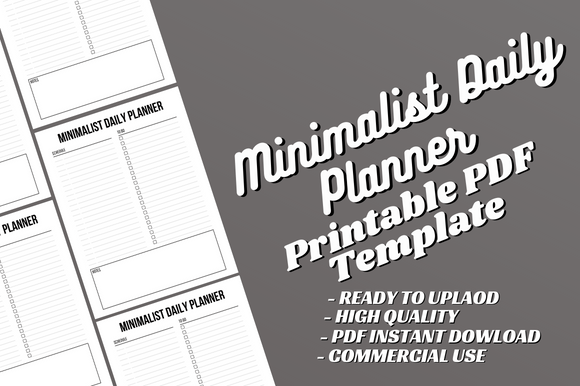
A Minimal To-Do List Planner isn't just a blank page. It is a thoughtfully designed template that guides you toward effective task management without forcing a rigid, complicated system. Its main characteristics are clean lines, ample space for writing, and a layout that prioritizes the task itself—what needs to be done, when, and perhaps a simple check box for completion. The value lies in its simplicity. For the beginner overwhelmed by productivity methodologies, or the seasoned professional tired of app notifications, it offers a calm, analog center. Its appeal is universal: it reduces the friction between having a task and recording it, making the act of planning feel less like a chore and more like a clear, intentional step.
Why might someone be interested in this? Common problems it addresses include:
- Decision Fatigue: Choosing between tags, projects, priority levels, and colors in digital apps can waste mental energy. A minimal template presents a single, straightforward field.
- Visual Overload: Busy backgrounds, multiple fonts, and irrelevant graphics can distract. A minimalist design clears the canvas for your content.
- Lack of Tangibility: For some, the physical act of writing with pen on paper creates a stronger cognitive commitment than typing on a screen.
- Need for Flexibility: Unlike preset software, a simple template can be adapted on the fly—a business objective, a creative project step, or a personal errand all fit the same basic box.
Where a Minimal Planner Enhances Daily Life
The application of a Minimal To-Do List Planner is vast because the need to track tasks is ubiquitous. In a personal context, it could be the central place for household management, weekly meal prep lists, or tracking hobby-related goals like learning a new skill. Creators, such as writers or artists, can use it to break down projects into daily actionable steps without getting lost in creative chaos.
For professionals, entrepreneurs, and small business owners, this tool can serve as a daily anchor. Imagine starting your workday by writing three to five critical tasks on a clean sheet—it forces prioritization. Bloggers and marketers can plot out content calendars or campaign stages. Educators can plan lesson sequences or administrative duties. Freelancers juggling multiple clients benefit from a unified, simple list to avoid mixing projects. The physical format also allows for quick desk reference, a meeting companion, or a bookmark in a project folder, integrating seamlessly into various workflows.
A Beginner-Friendly Example: Managing a Work Week
Consider a freelance graphic designer. Monday morning, they open their Minimal To-Do List Planner to a fresh page. They write:
- Finalize logo concepts for Client A (by Tuesday)
- Send invoice for completed Project B (today)
- Sketch initial ideas for Client C’s brochure (this week)
- Research new typography resources (low priority)
The list is visually quiet, so the designer’s attention stays on the tasks. As items are completed, they are checked off. The next day, a new page might be used, or the same page continued if the week’s layout allows. This repetitive, simple act builds a rhythm of accountability without any technical learning curve.
Important Considerations for Your Minimal Planner
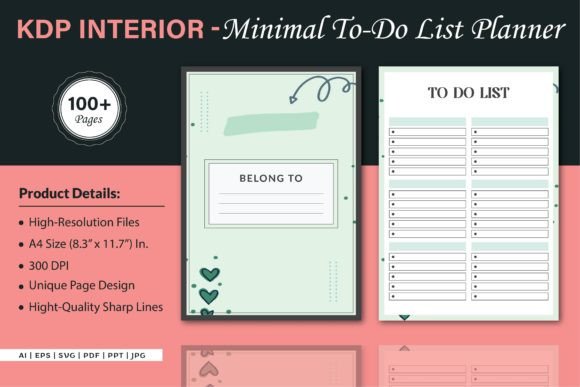
While the minimalist approach is powerful, its effectiveness depends on alignment with your habits. Before choosing or using such a planner, think about your natural workflow. Do you need space for notes alongside tasks? Does a purely daily format work, or do you need weekly overviews? The beauty of a template bundle, like the Minimal To-Do List Planner Templates – KDP Interior, is that it often provides variety within the minimalist framework. This specific offering includes 100 pages ready for upload to Amazon KDP, giving creators a complete product to share or use personally.
The technical specifications matter for practical use. The A4 size (8.3" x 11.7" inches) is a standard, comfortable format for writing. Having no bleed means the design is safe for standard printing without trimmed edges. The inclusion of multiple file types—AI, EPS, SVG, PDF, PPT, JPG—is crucial for different needs. The editable source files (AI and EPS) allow for customization if you want to adjust a color or font for your brand. The PDF is ready for immediate upload to KDP or personal printing. The extra cover page adds a professional finish. This versatility supports not only end-users but also entrepreneurs looking to create and sell their own planner variations on platforms like Amazon.
Integrating Digital and Analog Approaches
A minimal planner template bridges the analog and digital worlds. You can print the PDF and use it physically, enjoying the tactile benefits. Alternatively, you can use the JPG or PPT files digitally on a tablet with a stylus, combining the minimalist layout with digital convenience. The SVG format allows for use in web applications or further digital design. This flexibility means you aren't locked into one medium; you can adapt the tool to your current context, whether at a desk, in a coffee shop, or during a travel day.
Moving from Chaos to Calm Execution
Ultimately, a Minimal To-Do List Planner serves as a decluttering tool for your mind. It externalizes your commitments in the simplest form possible, reducing the anxiety of an unwieldy mental list. For the beginner, it introduces productivity without intimidation. For the busy professional, it offers a reliable, distraction-free checkpoint. For the entrepreneur or creator selling such planners, the provided template bundle—with its high-resolution interiors and ready-to-upload formats—represents a complete, market-ready product that aligns with this growing desire for simplicity.
If your goal is to focus more on doing tasks than on managing a complex system, exploring a minimalist planner approach is a sensible step. It encourages you to ask the fundamental question: “What truly needs to be done today?” and provides a clean space to answer it. Whether you use it for personal goals, creative projects, or business objectives, its value is proven in the calm, clear progress it helps you achieve, one checked box at a time.